Chase's two best-known no-fee cards look similar, and both earn the same kind of points, but they reward different habits. The Freedom Flex rewards you for tracking the calendar. The Freedom Unlimited rewards you for not thinking at all. This guide compares what Chase lists today, shows how to work out which one pays you more, and explains why many people end up holding both.
The two cards side by side
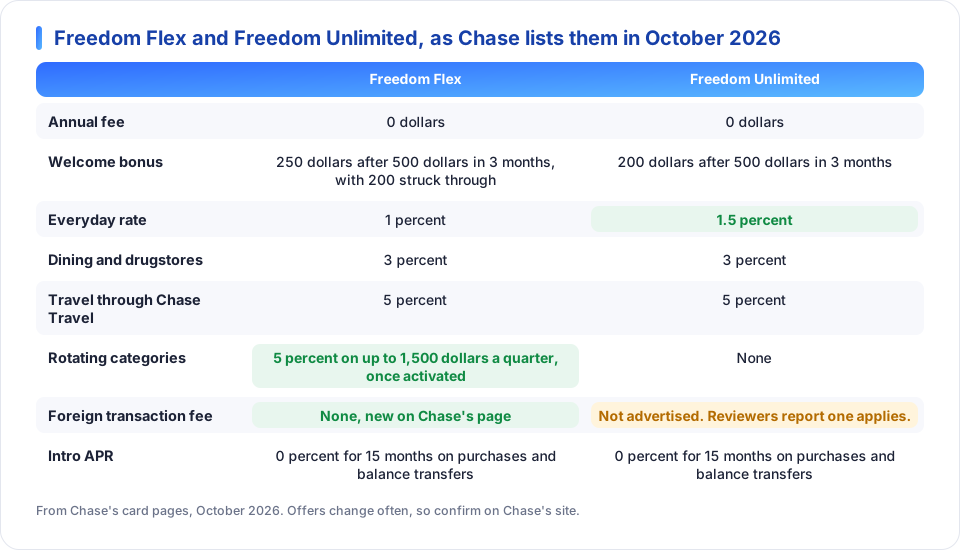
Both cards earn Ultimate Rewards points, which Chase markets as cash back. Chase says the rewards do not expire while the account is open and that there is no minimum to redeem for cash back. Both cards list a 0 percent intro APR for 15 months on purchases and balance transfers, and then a variable rate, and a balance transfer fee applies.
The Flex's rotating categories
Chase's page lists the next quarters, and you must activate each one to earn the 5 percent on up to 1,500 dollars of combined purchases.
| Quarter | Categories on Chase's page | Activation |
|---|---|---|
| July to September 2026 | Gas stations, public transit, EV charging, select live entertainment, United Way | Closed |
| October to December 2026 | Grocery stores except Walmart and Target, dining, American Red Cross | From 15 September 2026 |
| January to March 2027 | Grocery stores except Walmart and Target, top streaming services | From 15 December 2026 |
Which one pays more?
The Flex's extra comes from the 1,500-dollar cap. Spend all of it in a quarter's categories and you earn 75 dollars, against 22.50 on the Unlimited, so the Flex is ahead by 52.50 dollars a quarter, or 210 dollars a year if every quarter fits you. The Unlimited's counter is the 0.5 percent it earns on everything else: it takes about 10,500 dollars of other spending in a quarter before that closes the gap.
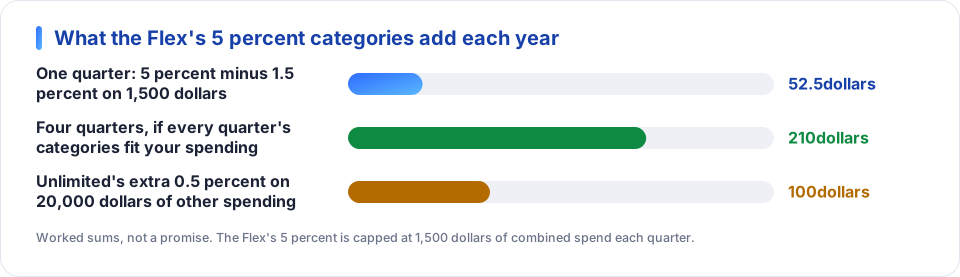
If you can hold only one, the Flex pays more for most households that will activate categories, and the Unlimited is the better choice if you want a set-and-forget card or spend heavily outside the categories. Holding both is the common answer: the Flex for the categories, the Unlimited for everything else.
Coverage and fine print
Both pages list purchase protection for 120 days up to 500 dollars an item, an extra year of warranty on eligible warranties of three years or less, and trip cancellation and interruption cover of up to 1,500 dollars per traveler and 6,000 per trip. Chase also lists 2 percent in total on Lyft rides through 30 September 2027 on both. Neither page lists cell phone protection, and reviewers report that the Flex's was discontinued in September 2026.
Welcome bonuses and the rules
Chase says each bonus is not available to current cardmembers or to anyone who received that card's new cardmember bonus in the past 24 months. Chase's 5/24 pattern, five or more new accounts in 24 months leading to a decline, and its pattern of declining more than two Chase cards in 30 days, are documented by the community rather than published by Chase. See the US application rules guide and bonus eligibility and the lifetime rule.
Check your count
Count new accounts in the last 24 months and whether you have had either card's bonus recently.
Pick the card that matches your effort
Choose the Flex if you will activate categories, or the Unlimited if you will not.
Plan the pair
If you will hold both, spend on the Flex only inside the quarter's categories and on dining, and use the Unlimited for the rest.
Think about transfers
The points are worth more with a transfer-eligible Chase card. See the guide to what points are worth.
Is it right for you?
Fits you
- You want no annual fee and are happy to earn 3 to 5 percent in a few categories.
- You plan to add a Sapphire or Ink Business Preferred later and want points to move with you.
- You will put dining, drugstore and grocery spending on the right card.
Think twice
- You want a card for foreign spending and the card you hold is the Unlimited.
- You will not activate categories each quarter.
- Your spending sits mostly outside the categories, where a flat 2 percent card beats 1.5.
See also which US cards are worth getting by spending style and Chase Sapphire Preferred versus Reserve.
Questions people ask
Can I hold both the Flex and the Unlimited?
Yes. They are separate products with separate bonuses, and many people hold both so that the Flex earns the 5 percent categories and the Unlimited earns 1.5 percent on everything else. Chase's 5/24 pattern and its two-cards-in-30-days pattern, which the community documents, can limit how fast you add them.
Do the rotating categories apply automatically?
No. Chase's page says you activate each quarter's categories to earn the 5 percent. Chase lists the activation start dates, and reviewers note that a new card is not activated for you, so put the dates in your calendar.
Which one has a foreign transaction fee?
Chase's page now advertises no foreign transaction fee on the Flex as a new feature. The Unlimited's page makes no such claim, and reviewers reported in June 2026 that it still charges one. Check the pricing and terms before you travel.
Do the points expire?
Chase says the rewards do not expire as long as your account is open, and there is no minimum to redeem for cash back. If you plan to close a card, move its points to another Ultimate Rewards card first.
Do I need a Sapphire to get the best value?
Not to earn, but yes to transfer. Chase points can move to airline and hotel partners only through a transfer-eligible card, and a Sapphire is the usual route. Without one the points are worth one cent each as cash back.
Sources
Written from these pages and checked against them on October 8, 2026. Programs and rules change, so check the provider’s current terms before you decide.
General information, not financial, legal or travel advice. Your own card terms and the provider’s current rules always come first.