The Ink Business Preferred is the Chase card most often described as the cheap way into transferable points for anyone with business spending. It costs 95 dollars a year, earns triple points on four everyday business categories, and, unlike Chase's no-fee Ink cards, can send points to airline and hotel partners. This guide sets out what Chase's own page says in October 2026, how to work out whether the fee pays for itself, and where the rules can stop you.
The card at a glance
- 95 dollars
- Annual fee
- 100,000
- Welcome points
- 3x
- Points per dollar
- 0
- Foreign transaction fees
As listed on Chase's page
After 8,000 dollars in the first 3 months
On four business categories, first 150,000 dollars a year
As stated on Chase's page
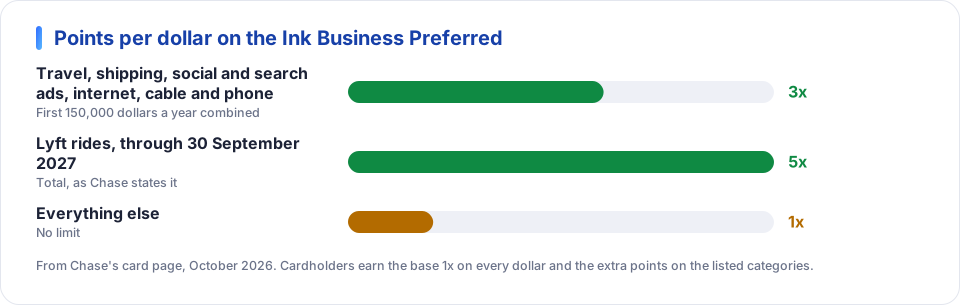
The four 3x categories are travel, shipping, advertising bought from social media sites and search engines, and internet, cable and phone services. The limit is 150,000 dollars of combined spend in each account anniversary year, which is the 12 months that start on your account's opening date. Chase also lists 5x on Lyft rides through 30 September 2027.
The welcome offer, and what it asks of you
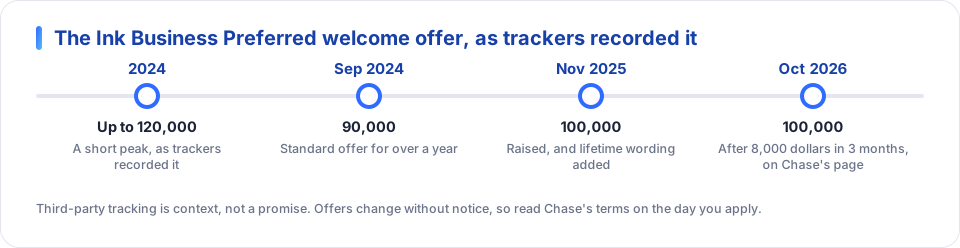
Chase's page lists 100,000 bonus points after you spend 8,000 dollars on purchases in the first 3 months. Chase says to allow 6 to 8 weeks for the points to post, and the account must be open and not in default when they do. Balance transfers, cash advances, cash-like transactions, gambling and fees do not count toward the spend.
What are 100,000 points worth? Redeemed for cash back they are 1,000 dollars, the floor. Reviewers value Chase points higher when they are transferred well, between roughly 1.5 and 2 cents each, which would make the offer worth 1,500 to 2,000 dollars. Use your own number, as how to price a sign-up bonus shows.
Does the 95-dollar fee pay for itself?
The card earns 2 extra points per dollar on the four categories compared with the 1x on everything else. At 1 cent a point you need 4,750 dollars of category spend in a year for the extra points to equal the fee. At 1.5 cents you need about 3,170 dollars, and at 2 cents about 2,380. The test against a flat 2 percent card is stricter, because that card already earns 2 cents on every dollar.
Benefits that can matter
| Benefit | What Chase's page says |
|---|---|
| Cell phone protection | Up to 1,000 dollars a claim for a phone on your bill when you pay it with the card, 3 claims in 12 months, 100-dollar deductible. |
| Purchase protection | Eligible new purchases for 120 days against damage or theft, up to 10,000 dollars an item. |
| Extended warranty | One extra year on eligible warranties of three years or less. |
| Trip cancellation and interruption | Up to 5,000 dollars per traveler and 10,000 per trip for prepaid, non-refundable expenses. |
| Auto rental coverage | Decline the rental company's collision cover. Primary for business rentals, up to 60,000 dollars for theft and collision. |
| DashPass | Complimentary for at least a year if activated by 31 December 2027, plus up to 10 dollars a month on grocery and retail DoorDash orders. |
| Employee cards | At no additional cost, with individual spending limits. |
Coverage terms sit in the Guide to Benefits that Chase sends after you open the account, so read it before you rely on any line above.
Points: where they can go
- Ultimate Rewards
- Chase's points currency, earned on Chase cards that earn points.
- Transfer partner
- An airline or hotel programme that Chase points can be sent to, usually at a fixed ratio.
- Anniversary year
- The 12 months from your account's opening date. The 150,000-dollar limit resets each year.
Chase lists these airline partners on the card's page: Aer Lingus AerClub, Air Canada Aeroplan, British Airways Club, Flying Blue, Iberia Plus, JetBlue TrueBlue, Singapore Airlines KrisFlyer, Southwest Rapid Rewards, United MileagePlus and Virgin Atlantic Flying Club. The hotel partners are IHG One Rewards, Marriott Bonvoy and World of Hyatt. Starting 1 October 2026, points move to Hyatt at 4 to 3, so 1,000 Ultimate Rewards points become 750 Hyatt points. Reviewers note that only the Sapphire Reserve cards still move 1 to 1.
Reviewers also note that holding a card that can transfer lets you send points earned on Chase's no-fee cards to partners too, so check each card's terms. For where to send points, see where to send flexible points in 2026.
The rules around applying
Chase's application is for a business, but a business can be a sole proprietorship, so freelancers, resellers and rideshare drivers apply. Do not overstate your revenue. Chase's 5/24 pattern, five or more new personal accounts in 24 months leading to a decline, is documented by the community and is not published by Chase. Business cards are reported not to add to the count, but you generally need to be under it. The US application rules guide lays out the order of operations.
Is it right for you?
Fits you
- You have real spending on shipping, advertising, travel, or phone and internet bills.
- You want transferable points at a low fee, or a way to use points from no-fee Chase cards.
- You travel and want no foreign transaction fee and phone cover.
Think twice
- You are over 5/24, or expect to be soon.
- Your business spend is too small, or too far from the four categories, to reach the break-even.
- You want plain cash back. A flat 2 percent card is simpler.
See also which US cards are worth getting by spending style and Chase Sapphire Preferred versus Reserve.
Questions people ask
Do I need a registered company to apply?
Reviewers report that a sole proprietorship, such as freelancing, reselling or rideshare driving, is accepted, using your own name and, if you have no EIN, your Social Security number. Answer every question truthfully. The account is a business account, and the income and revenue you state feed the decision.
Does it count toward Chase's 5/24 rule?
Reviewers report that Chase business cards are not reported to your personal credit file and do not add to your 5/24 count. You generally still need to be under 5/24 when you apply. 5/24 is a documented pattern, not a published rule, so confirm it with your own application.
How do I get value from the points?
Cash back is worth 1 cent a point and is the floor. Transfers to airline and hotel partners are where most of the extra value comes from, and the card can transfer points. Compare your options in the guide to what points are worth.
Do the points expire, and what if I close the card?
Chase says points do not expire as long as the account stays open, and that you lose them if the account is closed for misuse or fraud. Move your points to another Ultimate Rewards card before you close this one.
Ink Business Preferred or Sapphire Preferred?
Both cost 95 dollars and both transfer points. The Sapphire Preferred is a personal card whose categories lean to dining and travel, and it counts toward 5/24. The Ink earns 3x on business categories and does not count. If you have both kinds of spending, many people hold both.
Sources
Written from these pages and checked against them on October 8, 2026. Programs and rules change, so check the provider’s current terms before you decide.
Cards in this guide
General information, not financial, legal or travel advice. Your own card terms and the provider’s current rules always come first.