The most useful question about a credit card is not "what is the sign-up bonus?" but "what would I earn on the money I already spend, and what does it cost to keep?" This guide answers that for the US cards that come up most in 2026, using the fees and earning rates reported by US Credit Card Guide in September and October 2026. Offers, credits and rates change often, so read every number as a dated snapshot and confirm it on the issuer's page before you apply.
This is general education, not a recommendation to apply for any card. There are no referral links in it, and we earn nothing from any card named here.
Start with the floor: a flat 2%
Every card you add has to beat the simplest option, a card that pays the same rate on everything and charges no fee. Three no-fee cards set that floor.
- 2%
- Citi Double Cash on everything
- 2%
- Wells Fargo Active Cash on everything
- 1.5%
- Chase Freedom Unlimited on everything
1% when you buy, 1% when you pay
Flat, no categories to track
3% on dining and drugstores, 5% on travel booked through Chase
A fourth no-fee card, Citi Custom Cash, pays 5% on your top eligible category each billing cycle, on the first $500, then 1%. It picks the category for you from a list that includes restaurants, gas, groceries, select travel and transit, streaming, drugstores, home improvement, fitness and live entertainment. It rewards a spending pattern that is lumpy, not an even one.
Premium cards: what the fee buys
Six cards come up again and again. The table shows the headline earning and the one thing that usually justifies the fee.
| Card | Fee | Headline earning | What pays the fee |
|---|---|---|---|
| Citi Strata Premier | $95 | 10x on hotels, cars and attractions through CitiTravel; 3x on air travel, other hotels, restaurants, supermarkets, gas and EV charging; 1x elsewhere | Everyday 3x categories; $100 off a $500+ hotel stay once a year; no foreign transaction fee |
| Chase Sapphire Preferred | $95 | 5x on travel through Chase Travel; 3x on dining, select streaming, online groceries, gas and EV charging; 2x on other travel; 1x elsewhere | Up to $100 hotel credit through Chase Travel; transfer partners; primary rental car cover |
| Amex Gold | $325 | 4x at restaurants worldwide (to $50,000 a year); 4x at US supermarkets (to $25,000); 3x on flights booked direct; 1x elsewhere | Up to $120 Uber, $120 dining, $84 Dunkin' and $100 Resy credits, all needing enrolment and use; it is a charge card, paid in full each month |
| Capital One Venture X | $395 | 10x on hotels and cars and 5x on flights through Capital One Travel; 2x on everything else | $300 travel credit through the portal; 10,000 bonus miles every anniversary; lounge access for the cardholder |
| Chase Sapphire Reserve | $795 | 8x through Chase Travel; 4x on flights and hotels booked direct; 3x on dining; 1x elsewhere | A long list of credits (travel $300, dining, ride-hailing, streaming and more) plus lounges; not waived in year one |
| Amex Platinum | $895 | 5x on flights booked direct (up to $500,000 a year) and on flights and prepaid hotels through Amex Travel; 1x elsewhere | Airline fee credit of $200, many other credits, and the widest lounge access; not waived in year one |
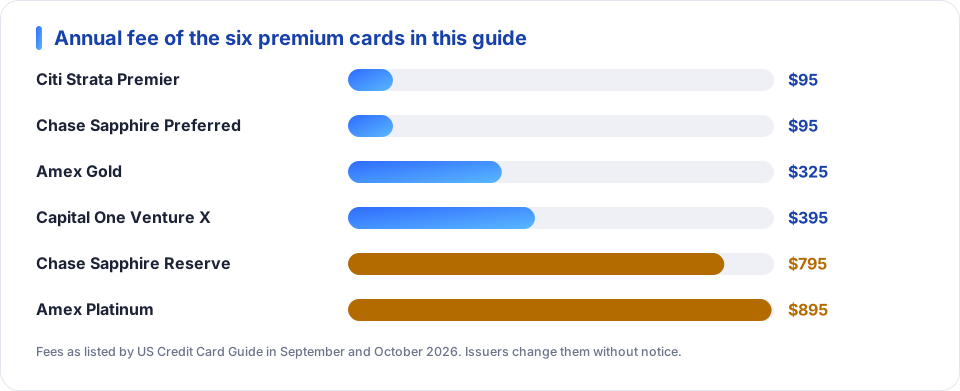
Two recent changes are worth knowing. Chase ended the Sapphire Preferred's 10% anniversary bonus on 15 June 2026. And since the 2025 refresh of the Sapphire Reserve and the Platinum, most of their value sits in credits that expire monthly, half-yearly or yearly.
The break-even test
Use one formula for any card:
The worked example below applies it to one household: $30,000 of spending a year, with a typical US mix. It shows each card at 1 cent a point (a statement credit or a cash-like redemption) and at 1.6 cents (the value US Credit Card Guide assigns to transfers to airline and hotel partners). Credits are left out on purpose, so you can add the ones you would truly use.
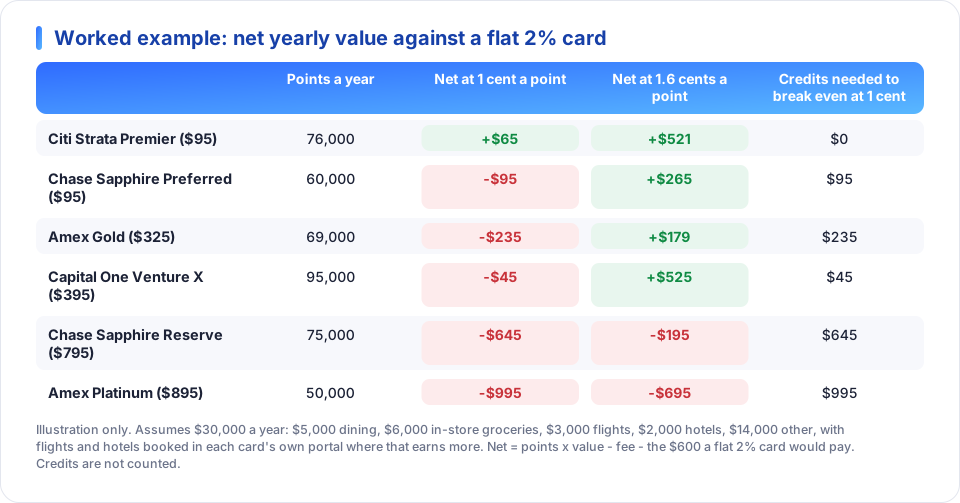
Three things stand out:
At 1 cent a point, most cards only tie a 2% card. The gap opens when you transfer points to partners and redeem them well. If you will not do that, buy the 2% card.
Venture X looks like a 2% card with perks. It earns 2x everywhere and pays 10,000 miles a year, which offsets most of its fee before any credit is counted.
The $795 and $895 cards are credit bundles. On this example they need $195 to $695 of credits at 1.6 cents, and $645 to $995 at 1 cent, to match a flat 2%. Count only credits you would have paid for anyway.
The rules that decide your order
Which card you can get, and which bonus you can still earn, depends on each issuer's rules: Chase's 5/24, Amex's once-per-lifetime bonus language, Citi's 8/65, and others. One example from the reviews: having held an Amex Platinum can make you ineligible for the Gold welcome offer, so if you want both, Gold goes first. The full list is in issuer application rules, and the language around bonus eligibility is explained in when you can earn a bonus again.
Three sensible lanes
If you are new to US credit, start with building credit as a newcomer before any of these.
Keep it simple
One 2% card for everything, plus Chase Freedom Unlimited or Citi Custom Cash if you spend a lot on dining or one category. No fees to justify.
Travel a few times a year
Add Citi Strata Premier or Chase Sapphire Preferred to lane one. Pay the $95 only if you will move points to partners or use the hotel credit.
Travel often
Capital One Venture X is the easiest premium card to justify. Amex Gold suits heavy dining and grocery spend. Take the Reserve or Platinum only after counting the credits you will really use.
Mistakes to avoid
Carrying a balance. Interest above 20% a year wipes out any reward. See how card interest works.
Spending to earn. A bonus that needs $5,000 of purchases you would not make is not a bonus.
Paying for credits you will not use. Credits that need enrolment, a particular merchant or a booking portal go unused more often than readers expect.
Ignoring the foreign transaction fee. Some no-fee cards charge about 3% abroad. The cards with none are listed in no foreign transaction fee cards.
Applying in the wrong order. One hard pull and one rule violation can cost you a bonus for years.
Questions people ask
Is a $95 travel card better than a 2% cash back card?
Only if the extra points on your own spending, valued at what you will really redeem them for, exceed the fee plus the 2% you would have earned anyway. In the worked example in this guide a $95 card beats 2% at 1.6 cents a point, but only just at 1 cent. Light travellers who redeem for cash should stay with 2%.
Which card should a first-time US cardholder get?
A no-annual-fee card you can be approved for, used lightly and paid in full. Premium travel cards are a second or third step, after you have a credit history. See the newcomer guide to building credit in this knowledge base.
Do the 1.6 cents per point figures apply to me?
They are one site's estimate for points moved to airline and hotel partners and used well. Cash or statement-credit redemptions are usually worth about 1 cent a point, so the guide shows both.
Do you earn anything if I apply for one of these cards?
No. There are no referral links, codes or affiliate links in this guide or anywhere in the knowledge base.
Sources
Written from these pages and checked against them on October 6, 2026. Programs and rules change, so check the provider’s current terms before you decide.
- US Credit Card Guide (further reading): Chase Sapphire Preferred review
- US Credit Card Guide (further reading): Chase Sapphire Reserve review
- US Credit Card Guide (further reading): Capital One Venture X review
- US Credit Card Guide (further reading): Amex Gold review
- US Credit Card Guide (further reading): Amex Platinum review
- US Credit Card Guide (further reading): Citi Strata Premier review
- US Credit Card Guide (further reading): Citi Double Cash review
- US Credit Card Guide (further reading): Wells Fargo Active Cash review
- US Credit Card Guide (further reading): Chase Freedom Unlimited review
- US Credit Card Guide (further reading): Citi Custom Cash review
General information, not financial, legal or travel advice. Your own card terms and the provider’s current rules always come first.