Every major bonus offer comes with small print: the bonus may not be available if you had the card before. Issuers rarely say how long "before" lasts, and the public data on it is mostly reader reports. This article separates what is published from what is only reported, so that you can plan an application sequence without counting on a second bonus.
What the issuers actually say
Chase's wording on Sapphire cards, as clarified in 2025 and 2026, says the new-cardmember bonus may not be available to you if you currently have another personal Sapphire card open, previously held this card or received a bonus for it. Chase also says it may consider how many cards you have opened and closed. Since June 2025 a pop-up on the application page can tell you that you are not eligible, which readers call "pop-up jail". American Express uses similar "lifetime" language across its cards.
Two details matter. First, the wording says "may", so it is a discretion, not a formula. Second, none of it overrides the issuer's other limits. Chase's 5/24 rule still applies to approval, so a bonus-eligible applicant can be declined for having too many new accounts (see US issuer application rules).
What crowd-sourced data shows
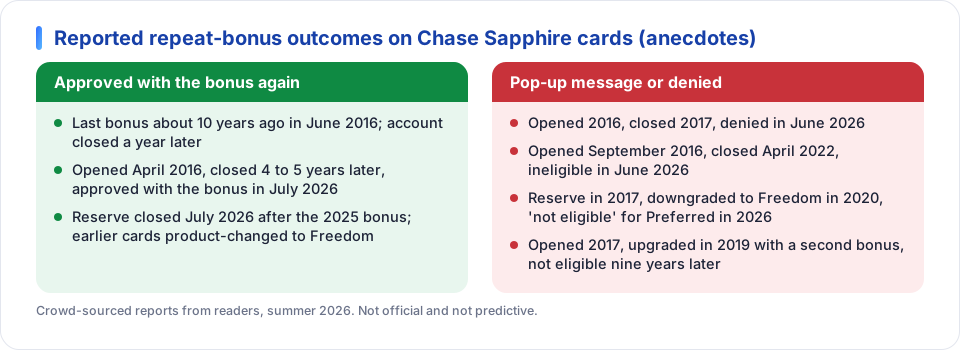
Doctor of Credit collected reader reports after Chase's 2026 clarification. TPG's early summary found that the people who were approved had first applied in 2010 to 2012, when the Sapphire Preferred launched, and cancelled by 2016 or 2017. The later reports are mixed. Some applicants were approved seven to ten years after the last bonus, while others were shown the pop-up four to nine years after closing.
Planning around the uncertainty
Treat the first bonus as the only one
If a second bonus arrives, it is extra. Choose a card for the product, not for a bonus you may not see again.
Read the application page
If the page says you may not be eligible for the bonus, stop and decide whether the card is still worth opening without it.
Do not rely on product changes
Moving a card to a no-fee version may keep an account open, but reports do not show that it resets eligibility.
Keep your account pattern ordinary
Issuers that review accounts at their discretion may also close them. See why issuers close accounts.
For how bonuses are structured, see sign-up bonuses explained and the annual fee break-even test.
Questions people ask
Does the 5/24 rule still matter if I am bonus-eligible?
Yes. Chase applies its own approval limits on top of bonus eligibility, so a repeat bonus does not cancel the rule that limits how many recent accounts you can hold when you apply.
Does product-changing a Sapphire to a Freedom card reset the clock?
Some reports say a product change made a later application eligible and others do not. There is no consistent pattern, so do not rely on a product change to reset anything.
How do I find out if I am eligible without applying?
The application page may show a message such as 'it looks like you are not eligible for a bonus'. Read it before you continue, because applying for a card whose bonus you cannot earn costs a credit inquiry and a new account for nothing.
Sources
Written from these pages and checked against them on October 6, 2026. Programs and rules change, so check the provider’s current terms before you decide.
General information, not financial, legal or travel advice. Your own card terms and the provider’s current rules always come first.