Ask what a point is worth and the honest answer is: it depends on what you do with it. The same 50,000 points can pay for a $500 statement credit or a business-class seat that would have cost $3,000. This guide gives you a ladder to rank programs, a formula for your own redemptions, and the reasons to spend points on a plan rather than save them for ever.
Three ways to redeem, three price levels
Cash or statement credit
Usually about 1 cent a point. Some programs pay less: Amex Membership Rewards points are worth about 0.6 cents as cash unless you hold a card that raises it. This is the floor you compare everything against.
A fixed-value travel portal
The issuer's own booking site sets a rate. Chase's Points Boost, as described in the 2026 card reviews, can reach about 1.5 cents a point for the Sapphire Preferred and up to 2.0 cents for the Sapphire Reserve on some flights and hotels, with 1.0 cent as the default. Better than cash, but the portal's prices may not beat booking direct.
Transfer to an airline or hotel partner
Where the large values live, and the risk. You move points one way into a partner program and then book an award at that program's price. Good redemptions return 1.2 to 1.6 cents or more, and rare long-haul premium-cabin awards return far more. Short domestic economy awards often return less than cash.
The ladder
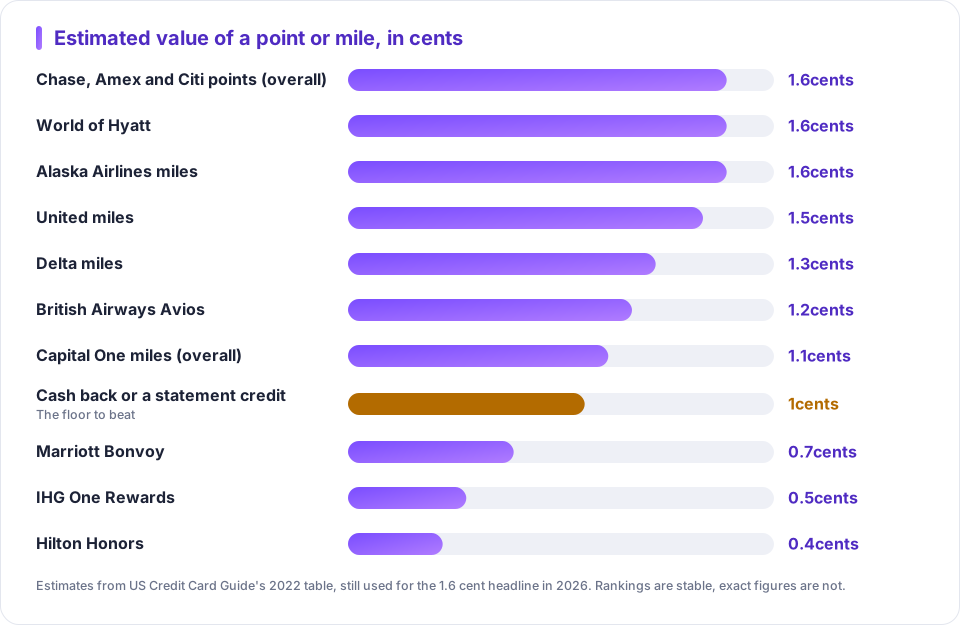
Read the ladder as a ranking. The bank currencies sit high because you can choose among many partners. Hotel points in programs with fixed award charts and many cheap rooms sit low, because the cash price of the room is low relative to the points.
Your own number
- 1.9 cents
- A $1,200 business-class fare for 60,000 miles and $50 in taxes
- 1.2 cents
- A $150 domestic economy fare for 12,500 miles and $5.60 in taxes
- 0.9 cents
- A $90 hotel night for 10,000 points and no fees
(1,200 - 50) / 60,000
(150 - 5.60) / 12,500
90 / 10,000
Use the cash price you would really have paid, not a rack rate no one pays. If the answer is under 1 cent, pay cash and keep the points for something better.
Value can drop without notice
Points are a currency their issuer can devalue. Two changes in 2026 show how. In March, Amex lowered its transfer ratio to Cathay Pacific's Asia Miles from 1:1 to 1:0.8. And Hyatt transfers from Chase Sapphire Preferred have moved to 4:3, with Bilt's Hyatt transfers following in 2027. Neither is a disaster alone, but both cut the value of points that were sitting unused. The practical rules: earn with a goal, redeem when you have a booking, and do not hoard for a trip you have not planned.
For the arithmetic behind cents per point, see rewards math. For where each currency can be sent in 2026, see where to send flexible points.
Questions people ask
Why do reviewers use 1.6 cents for Chase, Amex and Citi points?
It is one site's estimate of what the points fetch when transferred to airline and hotel partners and used well, including good international and premium-cabin awards. It is not what a typical redemption returns, and it is not guaranteed.
Is it better to take cash back or points?
If you will never learn a transfer partner, cash back at a flat rate is simpler and loses little. Points only pay when you redeem for more than the cash alternative and the extra is worth your time.
How old are the numbers in the ladder?
The per-program estimates come from a table last revised in January 2022, and the 1.6 cent headline is still used in 2026 reviews. Treat the ladder as a ranking of programs, not a price list.
Sources
Written from these pages and checked against them on October 6, 2026. Programs and rules change, so check the provider’s current terms before you decide.
- US Credit Card Guide (further reading): Estimated values for bank points, airline miles and hotel points
- US Credit Card Guide (further reading): Chase Sapphire Preferred review (Points Boost, Hyatt 4:3)
- US Credit Card Guide (further reading): Points to miles transfer chart (2026 changes)
- US Credit Card Guide (further reading): Bilt points review (Hyatt 4:3 from 2027)
General information, not financial, legal or travel advice. Your own card terms and the provider’s current rules always come first.