The Unicard is a Visa Signature card from E.SUN Bank in Taiwan. It pays rewards in E.SUN e points, which E.SUN values at NT$1 each, at one rate for everyday spending and a higher one at a list of designated merchants. What sets it apart is that you choose how the higher rate works. This guide goes through what E.SUN lists in October 2026, what each choice caps, and who should hold the card.
The card at a glance
- 1%
- Everyday spending
- +2% to +3.5%
- Designated merchants
- 4.5%
- Highest listed total
- NT$1
- One e point
With an e-bill and automatic payment, no cap stated. 0.3% with the e-bill alone
On top of the everyday rate, depending on the plan
UP plan only. Its extra is capped at 5,000 e points a month
How E.SUN values a point
How the reward is built
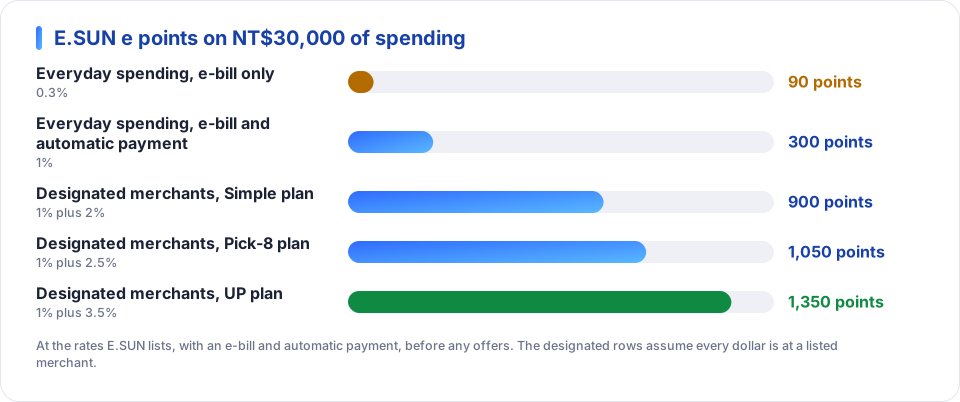
There are two layers. The first is everyday spending, which earns up to 1%. The second is an extra paid only on the designated merchants, and the plan you hold sets its size.
| Plan | Extra at designated merchants | Monthly cap on the extra | Listed total with the 1% |
|---|---|---|---|
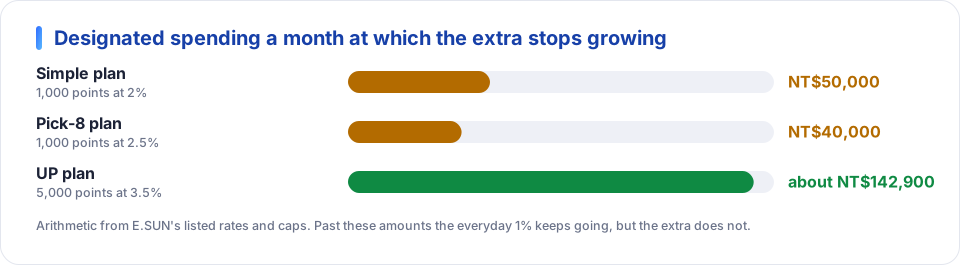
| Simple | 2% at any merchant on the list | 1,000 e points | Up to 3% |
| Pick-8 | 2.5% at up to 8 merchants you choose | 1,000 e points | Up to 3.5% |
| UP | 3.5% at any merchant on the list | 5,000 e points | Up to 4.5% |
- e point
- E.SUN's reward currency. E.SUN counts one point as NT$1 and rounds each transaction's reward to a whole number.
- Simple, Pick-8, UP
- The three plans. E.SUN's page calls them 簡單選, 任意選 and UP選.
- Designated merchant
- A merchant on E.SUN's list, which decides what earns the extra.
- Per customer
- E.SUN counts the caps across all of one customer's cards, not card by card.
E.SUN sets the Simple plan once the card is approved. You switch plans, or change your eight merchants on the Pick-8 plan, in the E.SUN Wallet app, up to 30 times a month in total, and only the main cardholder can do it. Additional cards follow the main card's plan.
What counts as everyday spending
The 1% needs both an e-bill and automatic payment of the card bill from an E.SUN Taiwan-dollar account, and the bill has to be paid successfully. With only the e-bill the rate is 0.3%. E.SUN's own examples show how rounding works: NT$100 on the e-bill-only rate is 0.3 points and earns nothing, while NT$520 earns 2 points at 0.3% and 5 points at 1%.
What does not count as everyday spending is set out in a separate E.SUN notice, covered in the next section. The Unicard page says the extra at designated merchants applies only to spending that counts as everyday.
What earns nothing at all
E.SUN publishes a notice, dated 1 September 2026, of spending that earns no e points on any payment method, and the Unicard page points to it for everything that is not everyday spending. The main groups are:
| Group | What E.SUN names |
|---|---|
| Convenience stores and PX Mart | 7-ELEVEN, FamilyMart, Hi-Life and OK Mart, and PX Mart, including Big PX Mart, PXGo online and payments with PX Pay or All Pay |
| Taxes, fees and bills | Tax payments, tuition, medical and government fees, vehicle-licensing fees, public payment platforms, and automatic debits for electricity, water, gas, street parking and telecoms |
| Prepaid value | Top-ups, including automatic ones, of stored-value cards and e-payment accounts, plus eTag top-ups and eTag parking fees |
| Insurance and investing | Designated insurance premiums, fund auto-debits, securities brokerage, overseas investment and currency-exchange platforms, traveller's cheques, gambling chips and digital currencies |
| Cash, charges and instalments | Cash advances, balance transfers, revolving interest, penalties, the annual fee, handling charges and merchant instalment purchases |
| Small-payment merchants | Car parks, restaurants, fast-food chains and vending machines that are processed through the Joint Credit Card Processing Center |
| Other | Tobacco and goods that cannot legally be promoted |
| Stores in Europe | Physical stores in the United Kingdom and 27 EU countries |
Paying for one of these through a third-party wallet or an e-payment account linked to the card earns nothing either.
Two lines touch the Unicard's own list. The Unicard page names the United Kingdom, France, Germany and Italy among its 18 countries for in-person spending, and the notice names the same four among the European countries where store purchases earn nothing. A few other E.SUN cards are exempt from the Europe line, but the Unicard is not on that list. The two pages do not say how they fit together, so ask E.SUN before you count on rewards in a European store.
The UP plan
UP costs 149 e points for each month, which E.SUN renews automatically on the 1st. It is free for a month if both of these were true in the month before:
Unicard spending of at least NT$30,000, counting main and additional cards.
Average assets with E.SUN of at least NT$300,000, which E.SUN defines as deposits, listed investment products and the premiums paid on valid policies, counted only as assets the policyholder holds with the bank.
If you do not meet both, E.SUN takes 149 points when it renews, and if you do not have them the card drops back to Simple. The points you would pay are worth NT$149 at E.SUN's own valuation.
For the method behind this, see annual fees and break-even.
What the designated list covers
E.SUN publishes the list on the card page for 1 July to 31 December 2026. The groups below are what it names. The notes are the ones that decide whether a purchase counts.
| Group | Examples E.SUN names | The catch |
|---|---|---|
| Mobile payments | E.SUN Wallet, LINE Pay, JKOPay, EasyWallet | Only with the Unicard linked. Convenience stores, PX Mart, taxes and fees do not count |
| Online shopping | momo, Shopee, Taobao, Coupang | Pay with the card itself, including through Apple Pay or Google Pay. Shopee cross-border orders do not count |
| Department stores | Shin Kong Mitsukoshi, Far Eastern, SOGO, Breeze, Taipei 101, LaLaport | A counter that bills under its own name, such as an Apple store inside a mall, does not count |
| Daily shopping and food | Watsons, Cosmed, UNIQLO, Uber Eats, foodpanda | Domestic stores only, and a shop inside a mall that bills under the mall's name does not count |
| Fuel and transport | CPC direct-run stations, 55688 taxis, Taiwan Railway, High Speed Rail, Uber | Rail only through official channels. Uber only for domestic rides paid in NT dollars |
| Airlines and travel | China Airlines, EVA Air, Japan Airlines, Peach, Trip.com, Booking.com, Agoda, KKday | Airlines only when bought from the airline. Booking sites only when paid online, not at the property |
| In person abroad | Japan, Korea, Thailand, Vietnam, Singapore, the United States, the United Kingdom, France and others, 18 in all | Face to face only. Online purchases do not count, and Guam is not counted as the United States. Europe is unclear, see "What earns nothing at all" |
Who should hold it
Fits you
- You spend steadily at the listed mobile payments, online shops, stores and airlines.
- You travel to the 18 listed countries and territories and pay in person.
- You already bank with E.SUN, so the e-bill and automatic payment are easy to set up.
Think twice
- Most of your spending is tax, convenience stores or PX Mart, none of which earns anything.
- You pay online abroad, which the face-to-face rule leaves out, or in stores in Europe, which the notice lists as earning nothing.
- You do not want to check a plan and a merchant list each month.
Set up the e-bill and automatic payment
Without both, the everyday rate drops from 1% to 0.3%.
Pick the plan from your own spending
Total your monthly spending at listed merchants. Stay on Simple if it is small, use Pick-8 if a few merchants take most of it, and consider UP if you are near its free tasks.
Check one statement against the list
Confirm the names printed on your statement match the merchants on E.SUN's list.
Look again before the list ends
The list runs to 31 December 2026 and E.SUN says it can change or end it, so check the next one before you rely on it.
See also paying abroad and cards with no foreign transaction fee.
Questions people ask
What does the Unicard earn?
E.SUN lists up to 1% back in e points on everyday spending: 0.3% with an e-bill only, and 1% with an e-bill plus automatic payment of the card bill from an E.SUN Taiwan-dollar account. Designated merchants add more depending on your plan, for a listed maximum of 3% on the Simple plan, 3.5% on the Pick-8 plan and 4.5% on the UP plan.
How much is an e point worth?
E.SUN says one e point equals NT$1. The reward on each transaction is rounded to a whole number, and a reward that rounds to less than one point is not paid.
Which plan am I on at the start?
The Simple plan. E.SUN sets it when the card is approved, and you can switch in the E.SUN Wallet app up to 30 times a month. The plan you hold on the last day of the calendar month decides that whole month's extra reward, which is paid from the 17th of the next month.
What counts as a designated merchant?
Only the merchants on E.SUN's list, and the name on the statement has to contain the merchant's name. A shop inside a department store or hotel that bills under the building's name does not count, and most categories need the physical card or a phone wallet linked to it rather than a third-party payment app.
What earns nothing at all?
E.SUN's notice dated 1 September 2026 lists spending that earns no e points on any payment method. It includes the four big convenience-store chains and PX Mart, taxes, tuition, medical and government fees, utility auto-debits, prepaid and e-payment top-ups, designated insurance premiums, investment platforms, merchant instalments, cash advances and in-store purchases in 28 European countries.
What is the annual fee?
The pages this guide was written from do not list it. The card library records NT$3,000 a year with the first year free, and a waiver from the next year if you spent at least once in the previous year and use an e-bill or automatic payment from an E.SUN account. Read E.SUN's fee page before you apply.
Sources
Written from these pages and checked against them on October 9, 2026. Programs and rules change, so check the provider’s current terms before you decide.
Cards in this guide
General information, not financial, legal or travel advice. Your own card terms and the provider’s current rules always come first.