Ask a few apps for your credit score and you will get a few different numbers. That is not an error. A credit score is the output of a formula applied to the data in one bureau's report, and there are several formulas and three bureaus. This guide explains why they disagree and which number counts.
Why there is more than one
The FTC describes a credit score as a number, usually between 300 and 850, that estimates how likely you are to repay a loan on time. The scoring system most lenders use is the FICO score. But FICO is not one number. Doctor of Credit counts dozens of FICO versions, including industry-specific scores for credit cards and auto loans, in addition to the classic scores issued by revision year and by bureau.
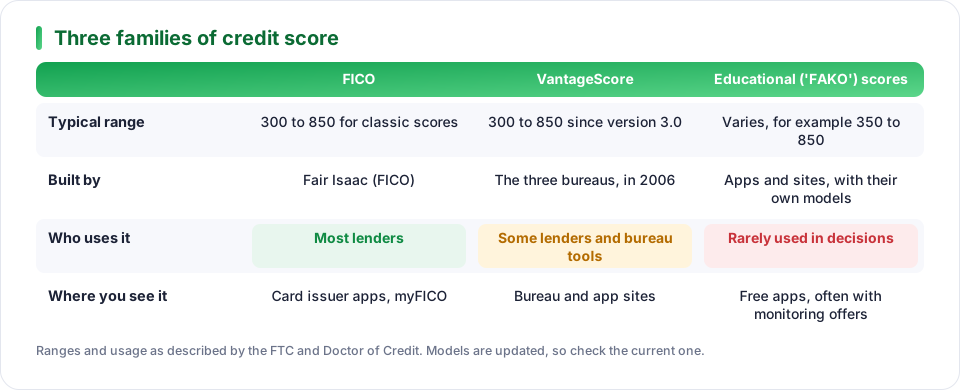
Add two more sources of difference. Each bureau (Equifax, Experian and TransUnion) holds its own data, so the same model gives different results on different reports. And scores change with the date, because the report changes whenever a lender reports to it.
The 'FAKO' scores
Doctor of Credit calls any score that is not a FICO score a "FAKO", a play on "fake" and "FICO". Free sites usually call these "educational" scores. Their trend is useful because they react to the same data. Their number is not the number a lender will pull. An app might show 780 while a lender's FICO version returns 745 (illustrative numbers). The gap is not a fault in either.
What to do with this
Pull your three reports
You can get them free every week from each bureau at AnnualCreditReport.com. Check names, addresses and accounts for anything you do not recognise.
Track one score, consistently
Choose a source, such as your card issuer's app, and watch its trend. Do not compare it with a different model.
Fix what is actually wrong
Only errors can be removed. The CFPB says no one can remove accurate negative information, so never pay a company to try. See disputing credit report errors.
Know which factors move it
Payment history and utilization dominate most models. See credit score basics and utilization.
Three mistakes to avoid
Comparing a score from one model with a score from another. A FICO score and a VantageScore for the same file can differ noticeably, and neither one is wrong.
Paying for score monitoring just to see a number. The free tools above are enough for most people.
Assuming a lender sees the same file you do. Each lender chooses its own bureaus and its own model, so the number it uses can differ from yours.
If you are applying for a card, ask a lender which bureau it pulls only if the answer matters, and avoid applying to many issuers in a short time (see soft and hard inquiries). If you have no US history at all, see building credit as a newcomer.
Questions people ask
Why is my app score different from the number a lender quoted?
They may use different models, different bureaus or different dates. Compare the same model from the same bureau over time rather than comparing two different scores.
Which bureau do card issuers check?
It varies by issuer and sometimes by state. Do not assume it. Check all three reports, and fix errors with each bureau.
Do I need to pay to see my score?
Not necessarily. Many card issuers show a score for free. Check whether a 'free score' offer comes with a monitoring subscription, as the FTC advises.
Sources
Written from these pages and checked against them on October 6, 2026. Programs and rules change, so check the provider’s current terms before you decide.
General information, not financial, legal or travel advice. Your own card terms and the provider’s current rules always come first.