SMBC Gold (NL) is a Visa or Mastercard gold card from SMBC Card in Japan, with no card number printed on it. It has a fee in the first year and a way to remove it for good. It earns a low base rate that SMBC tops up with a yearly bonus and a high rate at listed shops. This guide goes through what SMBC lists in October 2026, how the fee and the bonus work together, and who should hold the card.
The card at a glance
- ¥5,500
- Annual fee
- 0.5%
- Base rate
- +10,000
- Points each year
- 7%
- At listed shops
Charged in year one. Free later if you spend ¥1,000,000 in a year
One V point per ¥200
At ¥1,000,000 of spending
With phone contactless or mobile order
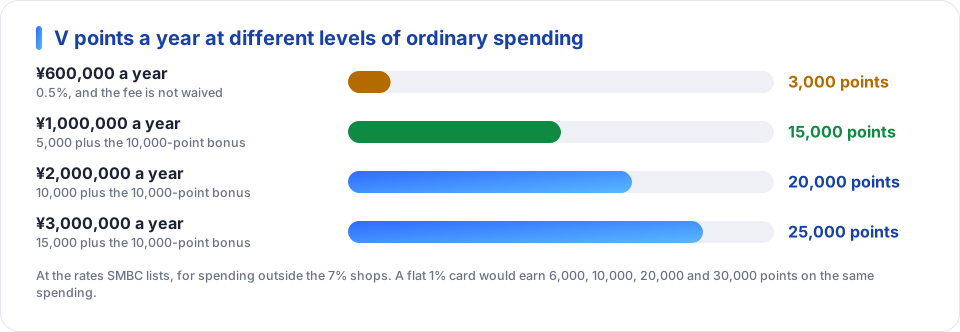
How the fee and the bonus fit together
SMBC ties both to the same figure. A year with ¥1,000,000 of spending removes the fee for every later year and pays 10,000 points. Family cards and child cards such as ETC cards are added to your count.
The year is not a calendar year. SMBC's own example is a card joined on 12 July 2021: the first period runs from that day to 30 June 2022, and later periods run from 1 July to 30 June. Reach ¥1,000,000 in the first period and the fee is free from the second year, with the 10,000 points credited by 31 July 2022. Miss it and the second year's ¥5,500 is charged, and the same test applies again in the second period. Someone who reached it in the first period is not tested again for the fee, but still needs ¥1,000,000 in a period to earn that period's 10,000 points.
- V point
- SMBC's points. For the base rate SMBC counts one point per ¥200 including tax.
- Number-less
- The card carries no number, expiry date or security code. You see them in SMBC's Vpass app.
- Olive
- SMBC's account-and-payment app. Its flexible pay credit mode earns a higher rate at the listed shops.
- Enrolment month
- The month the card is issued, which sets your yearly period and the month points are credited.
What does not count toward ¥1,000,000
SMBC's notes page lists spending that is left out of the count for both the fee waiver and the bonus.
| Group | What SMBC names |
|---|---|
| Fees and borrowing | Annual fees for the card, the ETC card and the PiTaPa card, cash-advance revolving, overseas cash service, loan repayments, and revolving and instalment charges |
| Investing and savings | SMBC Card's fund-investing instalments (SBI Securities), Sumitomo Mitsui Bank's foreign-currency automatic savings paid by card, and national pension premiums |
| Transport and e-money | Top-ups to transport and some other e-money, Mobile Suica commuter passes, express and Green tickets, and Mobile ICOCA commuter passes |
| Prepaid and payment apps | Top-ups to ANA Pay, Myakupe!, SMBC prepaid cards and the V Point Pay app, and from 1 March 2026 spending through au PAY, Kyash, JAL Pay and Bundle Card |
Three smaller rules matter as well. Cash-back from campaigns can be deducted from your total. A purchase whose sales slip reaches SMBC after the period ends does not count, which catches utility and ETC charges. And if you cancel the card, or SMBC suspends your membership, your progress resets and is not carried over if you rejoin.
The 7% rule
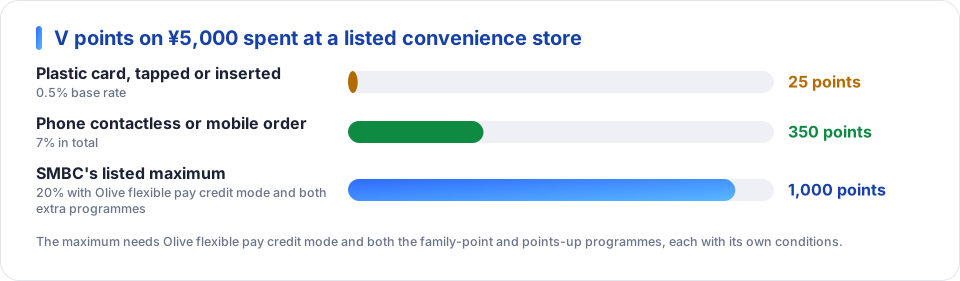
SMBC lists 7% in total at listed convenience stores and restaurants, made of the 0.5% base plus 6.5%. With Olive flexible pay credit mode the extra is 7.5%. The conditions are narrow, so check each one.
| How you pay | Earns the 7%? |
|---|---|
| Phone with Visa contactless or Mastercard contactless | Yes, at listed convenience stores and restaurants |
| Mobile order at listed shops | Yes |
| The plastic card tapped, iD, inserted or swiped | No |
| Mastercard contactless in Google Pay or Samsung Wallet | No. SMBC says the contactless payment is not available and no points are paid |
| A payment above about ¥10,000, where the terminal asks for the card to be inserted | No |
| A shop inside a commercial facility | May be excluded |
SMBC adds two more layers: a family-point extra of 1% for each registered family member up to 5%, and a points-up programme of up to 7% depending on your use of SMBC services. Together with Olive flexible pay credit mode they make SMBC's headline of up to 20%. Each has its own conditions.
Protection and perks
SMBC lists travel accident insurance of up to ¥20 million for overseas and domestic travel, on the condition that you pay the travel costs with the card in advance, and shopping protection of up to ¥3 million for goods bought in Japan or abroad. Shopping protection has a ¥3,000 deductible per incident and covers the purchase date plus 200 days. Gold also includes free lounge access at major domestic airports. For how lounge access works in general, see airport lounge access in 2026.
Does it pay off?
For the method behind this, see annual fees and break-even and what points are worth.
Who should hold it
Fits you
- You will spend ¥1,000,000 or a little more on the card each year, so the fee goes and the bonus arrives.
- You pay at listed convenience stores and restaurants with your phone.
- You want free lounge access at major domestic airports.
Think twice
- Your spending is under ¥1,000,000, which leaves a 0.5% rate and a fee.
- You spend more than about ¥2,000,000 a year and would earn more on a flat 1% card.
- You rely on the plastic card or on payments over about ¥10,000 at the shops, which miss the 7%.
Check you can apply
SMBC lists those aged 18 or over, excluding high-school students, with a stable continuing income, under Gold's own screening.
Plan the first year
The fee is charged in year one whatever you spend, so decide where the ¥1,000,000 will come from.
Set up phone payment
Add the card to your phone wallet and test a contactless payment at a listed shop before you rely on the 7%.
Read the counting rules
Check your enrolment date and the list above against what you plan to put on the card, then read SMBC's notes page.
See also Rakuten Card, a yen card with no annual fee and a flat 1%.
Questions people ask
What does the card cost?
SMBC lists ¥5,500 including tax, charged in the first year whether or not you reach ¥1,000,000. Reach it in that year and every later year is free. Miss it and the second year's fee is charged too, and SMBC's own example applies the same ¥1,000,000 test again in the second year. Family cards are free, and family and ETC card spending is added to yours for the count.
How do the points work?
SMBC pays one V point per ¥200 including tax, 0.5%. Each year you spend ¥1,000,000 it adds 10,000 points. The counting period starts on the day you join in the first year and on the 1st of your enrolment month after that, and runs to the end of the 11th month after the enrolment month. SMBC credits the points by the last day of the enrolment month after each period ends: for a card joined on 12 July 2021, the first period ends on 30 June 2022 and the points arrive by 31 July 2022.
When do I get the 7%?
At listed convenience stores and restaurants when you pay with Visa or Mastercard contactless on your phone, or by mobile order. Tapping the plastic card, iD, inserting the card and a swipe do not count. Neither does a payment above about ¥10,000, where the terminal asks you to insert the card. Some shops inside commercial facilities are excluded.
What protection and perks come with it?
SMBC lists travel accident insurance of up to ¥20 million at home and abroad, provided you pay the travel costs with the card first, and shopping protection of up to ¥3 million with ¥3,000 of your own cost per incident for the purchase date plus 200 days. Gold also includes free lounges at major domestic airports.
Who can apply, and how fast?
SMBC lists those aged 18 or over, excluding high-school students, with a stable continuing income, under screening of its own for Gold. The total limit goes up to ¥2 million. Instant issuance can show the card number in as little as 10 seconds, though not every time, and at night a temporary ¥50,000 limit applies until screening finishes.
Sources
Written from these pages and checked against them on October 9, 2026. Programs and rules change, so check the provider’s current terms before you decide.
Cards in this guide
General information, not financial, legal or travel advice. Your own card terms and the provider’s current rules always come first.