ICBC's WeChat credit card is built as a pair, and the pair is the point. One card is for spending at home on UnionPay, the other is a Mastercard made for travel. This guide explains what ICBC lists in October 2026, how the foreign-currency side works, and the interest wording that decides whether the card is cheap or expensive to use.
The pair at a glance
- 10
- Foreign currencies
- 0
- Conversion fee
- 5
- Purchases
- 3
- Grace days
Held on the Mastercard and posted without conversion
On foreign-currency spending, as ICBC lists it
Or CNY 5,000 of spending in a card year waives that year's fee
Plus a CNY 100 tolerance on the amount due
How the pair works
The UnionPay card is single-currency and is meant for spending in China. ICBC lists that purchases made through WeChat on the UnionPay card earn 1.5 times ICBC i-beans for each yuan. The Mastercard holds ten foreign currencies and is meant for travel. ICBC links the two accounts and suggests using one at home and the other abroad.
- Single-brand card
- A card that carries one network's mark. Here, one UnionPay card and one Mastercard.
- i-beans
- ICBC's points currency, which is what the UnionPay card's multiplier applies to.
- Dual-application chip
- The chip on newer ICBC Mastercards, which also lets the card make RMB payments in China.
Spending abroad
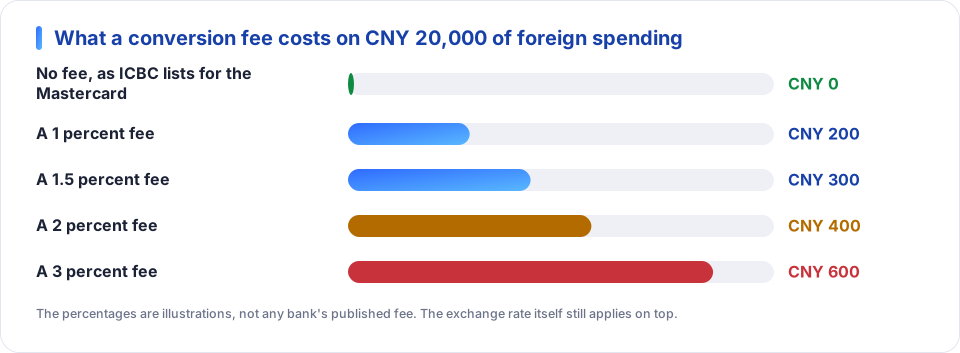
On the Mastercard, spending in one of the ten currencies posts in that currency, with no conversion and no conversion fee. In any other currency, ICBC says the system converts the transaction to US dollars, posts it to the dollar account and waives the conversion fee. You can repay in foreign currency, or have ICBC buy the currency with RMB.
The fee, the grace days and the interest wording
ICBC waives the annual fee for the card year after five purchases or CNY 5,000 of spending, and the card library records the fee at CNY 50 for the UnionPay card and CNY 100 for the Mastercard. ICBC also gives a 3-day grace period after the due date and a CNY 100 tolerance: if the unpaid part of the amount due is CNY 100 or less when the grace ends, it counts as paid in full and moves to the next bill.
The wording to read twice is the interest method. ICBC states that the WeChat card follows interest method one, which means that unless you repay the amount due in full, the whole amount loses its interest-free period, with interest charged from the posting date. Treat the card as one to pay off in full every month.
Apply for both cards
ICBC lets you apply for the UnionPay card and the Mastercard with one form.
Check the chip
A Mastercard issued or replaced after 17 March 2025 has the dual-application chip. If yours is older, use the upgrade in the ICBC app.
Link the UnionPay card to WeChat
That is the spending the i-bean multiplier applies to.
Pay in local currency abroad
Use the Mastercard and decline any offer to convert at the terminal.
Repay in full each month
This keeps you inside the interest-free period under method one.
Is it right for you?
Fits you
- You travel abroad and want one card with no conversion fee across ten currencies.
- You pay with WeChat in China and want the UnionPay card's i-bean multiplier.
- You can repay the whole bill every month.
Think twice
- You sometimes carry a balance, which under method one removes the interest-free period on the entire amount.
- You rarely travel, so the Mastercard's main benefit goes unused.
- You want lounge access or hotel credits, which ICBC's page for this gold-grade card does not list.
For a travel card with a high fee and lounge access, see airport lounge access in 2026.
Questions people ask
Why are there two cards?
ICBC issues a UnionPay card and a Mastercard together and links their accounts. It suggests using the UnionPay card in China and the Mastercard abroad, and you can apply for both with one form.
Which currencies does the Mastercard hold?
US dollar, euro, Hong Kong dollar, pound sterling, Japanese yen, Singapore dollar, Canadian dollar, Australian dollar, Swiss franc and New Zealand dollar.
What happens in another currency?
ICBC says the system converts the transaction to US dollars, posts it to the dollar account and waives the conversion fee. You can repay in foreign currency directly, or buy the currency with RMB.
Does the Mastercard work in China?
ICBC says Mastercards newly issued or replaced after 17 March 2025, with card numbers that start with 5, are dual-application chip cards with an RMB payment function. If yours is older, the ICBC app offers a chip upgrade under credit card and card benefits.
How does it appear on my credit report?
ICBC says multi-currency cards are reported by account, so the report shows an RMB account and ten foreign-currency accounts with the same card tail number. A late payment in one currency does not change how the other accounts display.
Sources
Written from these pages and checked against them on October 9, 2026. Programs and rules change, so check the provider’s current terms before you decide.
Cards in this guide
General information, not financial, legal or travel advice. Your own card terms and the provider’s current rules always come first.